
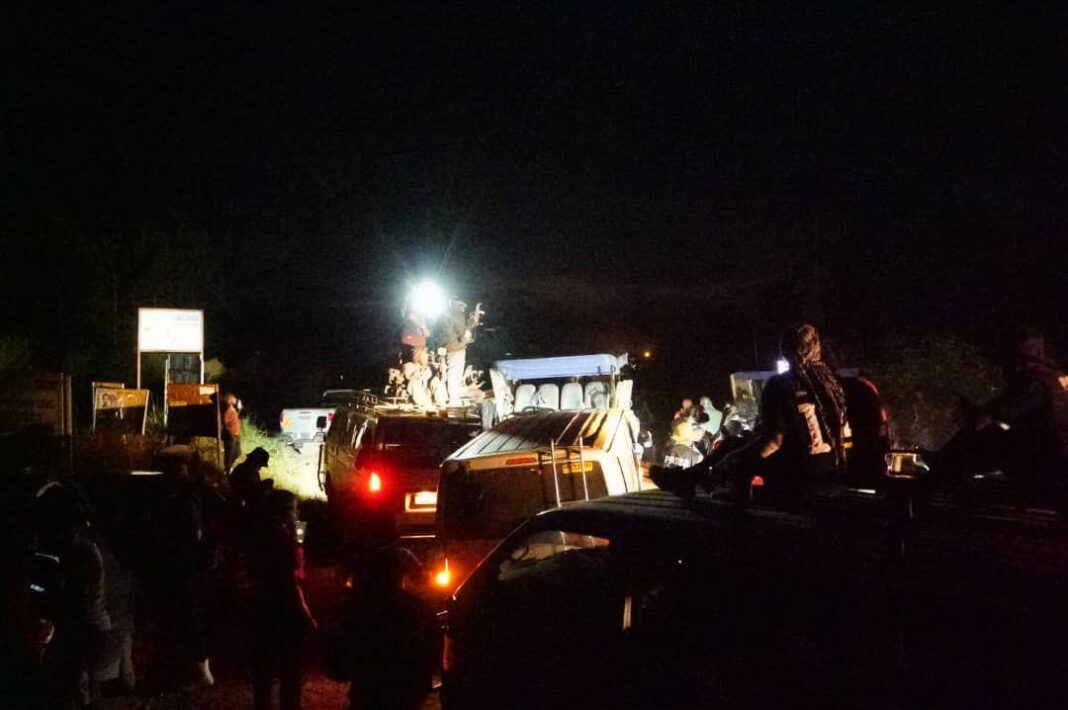

Ugandan police and military forces on December 17 repeatedly blocked the campaign convoy of National Unity Platform (NUP) president Robert Kyagulanyi, popularly known as Bobi Wine, during his campaign tour in eastern Uganda. The convoy was first intercepted in Amucu swamp before later being blocked again near Soroti City, disrupting scheduled campaign activities and preventing the opposition leader from accessing booked accommodation.
Security agencies said the convoy was stopped after Bobi Wine allegedly deviated from the approved campaign program in Katakwi and Kapelebyong districts. Police claimed that instead of addressing supporters at officially cleared venues, the NUP leader made stops at trading centers, which they said violated campaign guidelines.
Our team has been blocked from proceeding to Amuria district where they are meant to access accommodation. The criminal regime security forces have mounted a road block in Amucu swamp, along Amuria road!#FreeUgandaNow pic.twitter.com/dm8AQXZCGo
— National Unity Platform (@NUP_Ug) December 17, 2025
Authorities also pointed to enforcement of the 6:00 p.m. campaign curfew as part of their justification for blocking further movement.
Bobi Wine Accuses State of Harassment and Intimidation
Bobi Wine strongly condemned the actions of the security forces, accusing the government of orchestrating harassment and intimidation aimed at undermining opposition activities ahead of the 2026 general elections.
He insisted that neither he nor his party has ever called on supporters to riot, emphasizing that NUP’s message is centered on peaceful protest, a right he said is clearly protected under Article 29 of Uganda’s Constitution.
According to Kyagulanyi, labeling citizens as rioters is a deliberate attempt to criminalize legitimate political expression. He argued that Ugandans have a constitutional right to assemble, express dissent, and demand accountability from those in power without fear of violence or repression.
NUP Says Protest Vote Is Conditional
In his statement, Bobi Wine stressed that NUP’s call for a protest vote is not unconditional. He said protests would be unnecessary if the government guaranteed transparent, free, and fair elections. He accused state agencies of already interfering with the electoral process by blocking opposition campaigns, denying NUP access to radio stations, abducting supporters, and illegally arresting campaign coordinators across the country.
Kyagulanyi maintained that these actions amount to early rigging of the electoral process and leave citizens with no option but to demand electoral justice through peaceful protest. He added that stopping these practices would immediately remove any justification for public demonstrations.
The NUP leader also criticized President Yoweri Museveni’s recent remarks referencing the number of bullets issued to soldiers, saying such statements suggest a willingness to respond to peaceful protests with lethal force. Bobi Wine described this as deeply troubling, arguing that a government that prepares bullets instead of dialogue reveals fear of its own people.
Despite the threats, Kyagulanyi insisted that no regime can silence an entire population. He said Ugandans will ultimately decide their future through collective action and constitutional means.
Blocked From Accommodation in Amuria and Soroti
The situation worsened later in the evening when security forces blocked Bobi Wine’s team from Amuria District, where they had already paid for and booked accommodation for the night. Faced with no alternative, the convoy decided to travel to Soroti City in search of safety and rest.
However, the convoy was once again intercepted in Otuchopi, just before entering Soroti City. According to Bobi Wine, military and police officers refused to allow the team access to alternative accommodation they had booked in the city. The repeated roadblocks left the convoy stranded and heightened fears over the intentions of security forces.
Bobi Wine Raises Fears of Assassination Plot
Following the latest blockage, Bobi Wine said the repeated targeting of his movements raised serious concerns about his personal safety. He claimed that he is aware of alleged plans by the Museveni government to assassinate him before voting day, describing the situation as dangerous and unpredictable.
Although no official injuries were reported during the incidents, the repeated confrontations further deepened mistrust between the opposition and security agencies.
Museveni Dismisses Claims, Defends Security Actions
President Yoweri Museveni dismissed Bobi Wine’s allegations, insisting that Uganda remains stable and peaceful. The president and government officials maintain that security forces are simply enforcing the law and ensuring order during the campaign period.
QUOTE: “Don’t listen to [Robert] Kyagulanyi; his comments [about our security] lack foresight. His claim that there are not enough soldiers to match rioters is misguided. One soldier carries 120 bullets… do the math. Uganda can not be destabilised, and anyone who attempts it… pic.twitter.com/60LnGY7f4S
— Daily Monitor (@DailyMonitor) December 17, 2025
Authorities argue that all candidates must respect approved schedules, designated venues, and curfew regulations. They insist that these measures are necessary to prevent disorder and maintain national stability as the country moves toward the 2026 elections.
Museveni: “I’ve heard Kyagulanyi say that soldiers and police are few while rioters are many. I advise you not to believe him. Every soldier and police officer has a gun with 120 bullets. First, calculate the total bullets per gun.”
Polling Day Debate Fuels Protest Vote Campaign
The standoff has also reignited debate over voter conduct on polling day, a key issue in NUP’s protest vote campaign. Government officials maintain that voters must leave polling stations immediately after casting their ballots, arguing that remaining near polling areas poses a security risk.
NUP and Bobi Wine, however, encourage voters to remain within the polling station perimeter to protect their votes and deter electoral malpractice. They argue that citizen presence is essential in preventing vote tampering and ensuring transparency.
What the Law and Constitution Provide
“Statement on Incidents of Political Activities Involving the NUP Presidential Candidate in Katakwi and Kapelebyong Today, 17th December 2025, the NUP presidential candidate, Hon. Robert Kyagulanyi, was scheduled to conduct campaign rallies in Katakwi District at Toroma Primary School and Toroma Town Council, Ocorimongin Primary School (Katakwi Town Council), and Usuk Sub-county.
In Kapelebyong District, the scheduled venue was Kapelebyong Primary School, Kapelebyong Town Council. In Amuria District, the previously agreed campaign venues were Amuria Secondary School and Orungo Town Council playgrounds. Hon. Robert Kyagulanyi arrived from Kumi via the Gweri–Toroma Road en route to Toroma Primary School, his first scheduled campaign venue. Along the way, he made two unauthorized stopovers at Gweri Trading Centre and Omasitei Trading Centre in Soroti District.
He arrived at Toroma Town Council at about 1340 hours. Instead of proceeding to the agreed venue, he addressed people along the roadside in Toroma Town Council, contrary to the approved campaign plan. He later proceeded to Katakwi Town Council for his second scheduled rally. However, upon reaching the Moroto–Soroti Road junction, he declined to proceed to Ocorimongin Primary School, the agreed campaign venue. He had a stand off with security officers for over 30 minutes, thereby disrupting the planned activities. Following the incident, the candidate was advised and guided to proceed to Kapelebyong District for his next scheduled rally. Hon. Robert Kyagulanyi arrived at Kapelebyong Primary School at about 1700hours, and the rally ended at around 1750 hours.
Due to time constraints, the candidate did not proceed to Amuria District to conduct the scheduled campaign rallies. By the time activities concluded in Kapelebyong, it was past 1800 hours, which is beyond the authorized campaign time. After the Kapelebyong rally, Hon. Robert Kyagulanyi was guided to use the Kapelebyong–Apedur Road. Upon reaching the Acowa–Amuria Road, security advised him to use the Acowa–A kotomit–Abarirelela–Wera Town–Soroti Road for safety and compliance purposes. The candidate declined this guidance and instead parked, stating his intention to proceed to Amuria Town, which was declined by security agencies as it was outside the authorized campaign time”
Legal analysts point to Uganda’s electoral laws and constitutional provisions, which allow a voter to remain up to 20 meters away from a polling station, provided they do not interfere with voting or counting. This provision, according to NUP, gives citizens the legal right to peacefully observe and safeguard the electoral process.
As the 2026 elections draw closer, the repeated blocking of opposition campaigns highlights growing political tension in Uganda.
Whether these security actions amount to lawful enforcement or political suppression remains sharply contested, with many Ugandans closely watching how constitutional rights, electoral freedom, and state power will be balanced in the months ahead.